Virtual try-on Was Never Supposed to Be an Act of Self-Criticism
REDESIGNING THE MAKEUP TRIAL EXPERIENCE FOR M·A·C — FROM SELF-SCRUTINY TO GUIDED IMAGINATION.

A Psychological Barrier the Industry Has Overlooked
Virtual try-on technology has existed for years. Conversion rates have not matched expectations.
The technology is not the problem. The user's psychological state is.
When a camera points at someone's face, attention shifts — to pores, asymmetry, uneven skin tone. What was designed to help someone choose a product becomes an exercise in self-criticism. The more they look, the less confident they feel. The less confident they feel, the less likely they are to decide.
Traditional virtual try-on optimizes for realism. In doing so, it amplifies exactly the kind of pressure that makes purchase decisions harder.
A Different Framing
The issue is not that the technology is insufficiently realistic. The issue is that the act of looking at yourself while making a purchase decision is psychologically counterproductive.
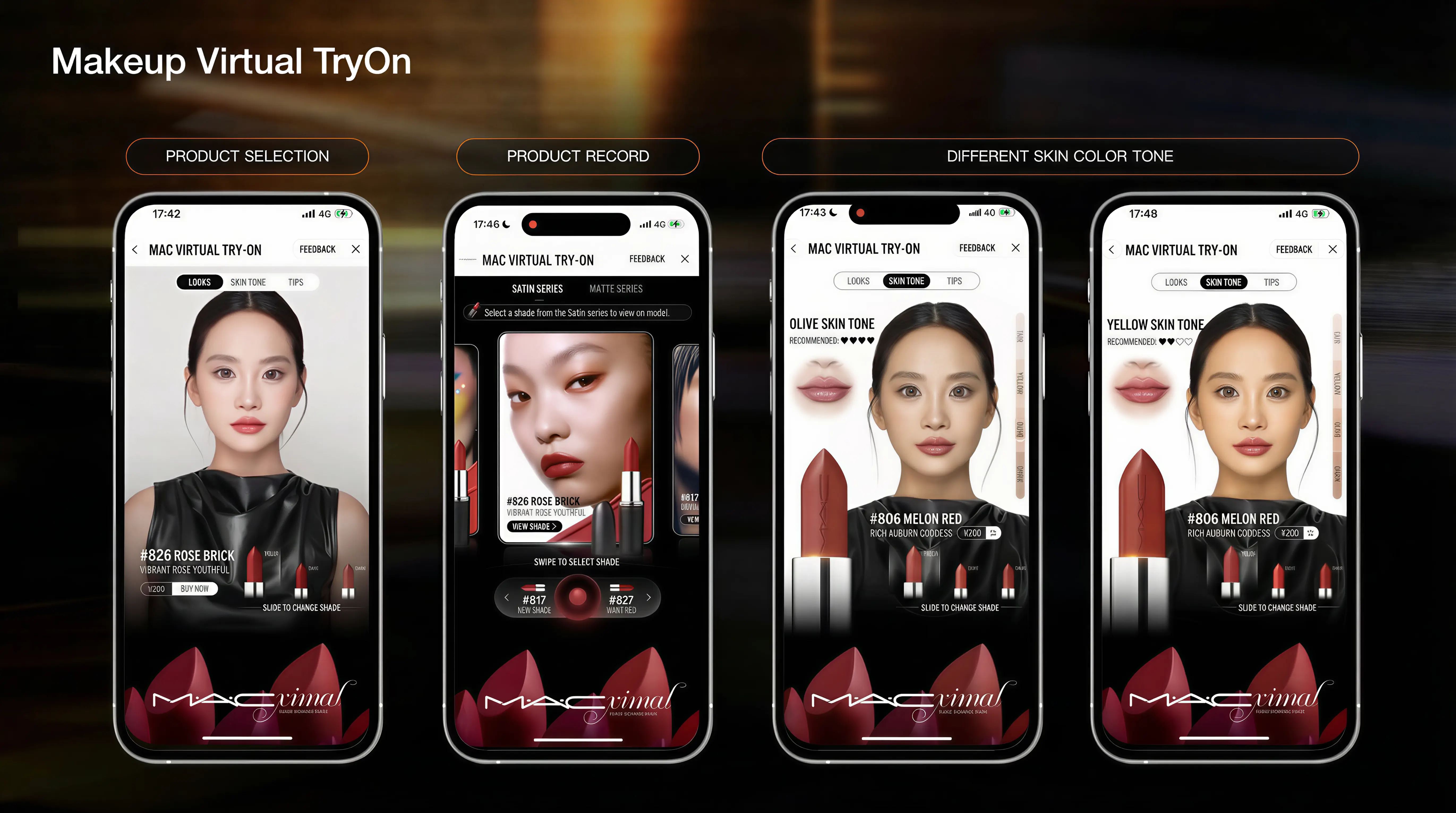
We redefined the try-on experience as guided imagination — not applying products to the user's own face, but exploring possibilities through curated digital models across diverse skin tones and facial structures.
This shift changes everything. Users move from evaluating themselves to exploring possibilities. From defensive to open. From hesitant to decisive.
What We Designed
A virtual try-on experience for M·A·C built around the principle of guided imagination.
Curated digital models span diverse skin tones and facial profiles, allowing users to find the closest reference to themselves without the pressure of direct self-viewing. A skin tone matching system accelerates shade selection, reducing decision fatigue. Scene-based try-on environments — indoor light, outdoor light, live-streaming contexts — show how looks perform across real-life situations, giving users a basis for decision rather than a moment of doubt.
Every interaction step was restructured around a single goal: make the decision faster and more confident.
What This Changes
When try-on shifts from scrutiny to imagination, users engage more deeply, stay longer, and convert at higher rates.
They are not testing a filter. They are previewing a version of themselves they want to become. That sense of possibility — not technical accuracy — is what drives purchase confidence.
If your brand is working on making virtual try-on genuinely convert rather than simply function, we are ready to work on it with you.
Creative Direction & Experience Design: Riseon Design
Project Type: Commercial Project
Scope: Virtual Try-On Experience · Beauty UX Design · Consumer Psychology & Conversion Design